

Retail Owners Are Burning Out—But It Doesn’t Have To Be This Way
Nothing tests a retail owner like the chaos of a normal Tuesday.
A shipment arrives early. Your part-timer texts that they’re sick. A customer needs help with sizing. Shopify dings with an order you have to fulfill. Meanwhile, you promised yourself you’d finally fix that abandoned email list…but the day eats your time before you can even open Gmail.
Most retail businesses run like this:
Fast, reactive, and one bad week away from total disarray.
This is exactly why I built the Retail Systems Starter Kit—the same tools I wish I had when I was running my own consignment store and managing a second retail location…right up until life knocked me on my back.
Why Every Retail Store Needs Systems (Before You Think You Need More Staff, More Inventory, or More Hours in the Day)
Retail owners usually blame their overwhelm on the wrong things.
They think they need:
• one more employee
• a bigger space
• a tighter schedule
• a fancier POS system
What they actually need is far simpler:
repeatable systems that stop the chaos before it starts.
Systems are the difference between:
• a business that drains you
• and a business that runs whether you’re in the store or not
Most owners resist them because they feel too “corporate” or complicated. But real systems—good ones—are the opposite. They simplify, not complicate. They tell your team exactly how things should be done so you don’t spend your life answering the same questions, fixing the same problems, or cleaning up the same mistakes.
Systems create consistency.
Consistency builds trust.
Trust drives sales.
It’s not magic. It’s operations.
My Story: How the Lack of Systems Forced Me to Close My Consignment Store
When people hear I used to run a consignment store, they imagine it closed because sales were slow or the location didn’t work.
The truth was far more personal.
I got sick with diabetes.
Not the “take a few days off and bounce back” type of sick. The kind that takes you completely offline—mentally, emotionally, and physically.
And when I stepped back, my store collapsed within weeks.
Not because it didn’t have potential. Not because customers weren’t coming.
It collapsed because everything depended on me.
• Only I knew how to intake consignment items
• Only I could price new inventory
• Only I could run the POS correctly
• Only I knew how to restock, refund, discount, or close the store
• Only I knew how our emails were sent (or…not sent)
My store didn’t close because it failed.
It closed because my systems failed.
And when my systems failed, I had nothing supporting me.
That moment changed everything about how I operate now.
It’s why I teach systems—not just for growth, but for protection.
Your business should be able to breathe even when you can’t.
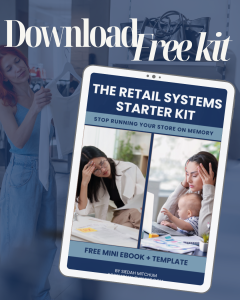
If you want to read more of that journey, I share it fully here:
➡ https://payhip.com/b/IFXwx
How Systems Transform a Retail Business from “Firefighting” to “Flow”
Retail thrives on three things:
visibility, consistency, and energy.
Systems give you all three.
Here’s what happens once you implement them:
You gain time back.
Tasks stop living in your head. Your team can run the day without constant supervision.
Your customer experience becomes predictable.
Every shopper is greeted, checked out, and supported the same high-quality way—no more random, inconsistent interactions.
You stop losing money to human error.
Pricing mistakes, inventory mistakes, return mistakes, and staffing mistakes drop dramatically.
Your marketing actually drives revenue.
Because now you have the structure to send emails, gather birthdays, track promotions, and measure results.
Your stress levels fall.
A system-driven store feels lighter. You walk in and feel in control, not behind.
This is why the Retail Systems Starter Kit exists—to give you the starting blueprint without the overwhelm.
And it begins with the simplest system of all.
The One System You Can Build in 10 Minutes: SOPs
SOPs—Standard Operating Procedures—sound dry, but they’re the backbone of a smooth retail business.

Most owners skip SOPs because they imagine a corporate binder written in legal jargon. In reality, an SOP should be simple enough that a new team member can follow it without any help.
This is the first system every single retail store needs:
your team must know how things work without asking you.
You can build your first SOP in less than 10 minutes.
Pick one task someone asks you about constantly:
• “How do I process returns?”
• “Where do we put the candle refills?”
• “What time do we count the register?”
Write the steps.
Screen record if needed.
Add a couple photos.
Boom. You’ve created your first system.
Inside the Retail Systems Starter Kit, I give you plug-and-play retail SOP templates so you can speed through this step even faster.
➡ Get your SOP templates here:
https://payhip.com/b/wt5mo
The System You Don’t Have That’s Costing You Money Daily: Email Marketing
If SOPs save you time, email marketing saves your revenue.
Most retail owners underestimate email because:
• Instagram feels easier
• TikTok feels trendy
• Shopify sales “just happen”
• They don’t want to “annoy” customers
But here’s the truth retail rarely admits:
Email is the highest-ROI channel you have. Period.
It’s not optional. It’s essential.
And right now, it might be the biggest hole in your business.
What a Good Retail Email System Looks Like
Think about brands who email you well.
Like Sephora—they email every time you:
• have points
• have a birthday
• qualify for a sale
• haven’t shopped in a while
• have a beauty profile update
Every email is relevant, specific, and personalized.
Earthbound Trading Co. does the same—monthly birthday deals, seasonal promos, reminders, a strong point-of-view in every email.
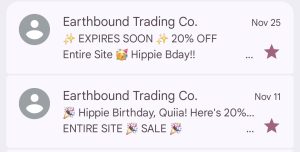
New Moon Beginnings—their Mother’s Day emails, lunar-cycle deals, and monthly specials keep you coming back all year.

These emails aren’t random. They are systems:
• automated flows
• segmented lists
• birthday triggers
• holiday triggers
• VIP triggers
Small retail stores can do this too.
In fact, you must—because customers expect it now.
Here’s what you should have:
-
A welcome sequence (2–4 emails)
-
A birthday offer (automated forever)
-
A monthly new arrivals email
-
An abandoned cart email (even simple ones convert)
-
A VIP customer flow for your best buyers
If you don’t have these, money is leaking out the back of your store every single day.
You don’t need a big list.
You need a smart list.
Note: Strive to be consistent because as you see by being your favorite stores email list they are sending emails multiple times a month. There is POWER in having an email list.
And you already have the help you need:
—
Linked Resources You Can Add to This Section for SEO Strength:
• 9 Game-Changing Tips to Supercharge Your Email Sales Funnel
• Automated Email Sequences That Convert
• Sales Email Automation for Product Businesses
—
These internal links strengthen SEO, keep readers on your site longer, and show Google your content is deep and interconnected.
Real Examples Of What Effective Retail Emails Look Like
Sephora’s Insider Specials:
They send layered emails with expiration dates—urgency without pressure. They highlight rewards because humans love progress.
Earthbound’s Birthday Sale + Reminder:
Brilliant use of extended birthday windows. This is why you received a reminder from Nov 18 to December 11. Long runway = more time to shop = more revenue.
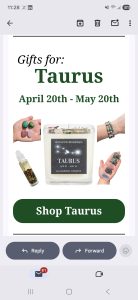
New Moon Beginnings Monthly Specials:
They align promotions with their brand identity (moon cycles, intention-setting). This makes their emails feel natural instead of salesy.
The message your readers should walk away with:
These big brands aren’t sending emails “when they feel like it.”
They run operational email systems.
And those systems print money on autopilot.
Small boutiques can replicate this with the same structure—even with 50 people on their list.
The Missing Piece: Operations Management Your Team Can Follow
Operations management isn’t about being strict—it’s about reducing mental load.
A retail store runs on predictable rhythms:
daily → weekly → monthly → quarterly
If your tasks aren’t mapped into that rhythm, they’ll pile up until they smother you.
Here’s how operations become manageable:
Daily:
• open/close procedures
• restocking
• register counts
• floor checks
Weekly:
• inventory review
• social + email marketing
• cleaning
• scheduling
Monthly:
• reporting
• promotions
• vendor orders
• staff development
When these tasks are built into SOPs, checklists, and recurring cycles, your store becomes calmer, cleaner, and more profitable.
Consistent operations turn a retail business from a job into a system.
Your Next Step: Start With the System That Gives You Time Back Immediately
Let’s keep it simple.
Out of everything you could do today, one action gives you the biggest payoff:
Build your first SOP.
That single step starts a domino effect:
• fewer questions
• fewer mistakes
• less stress
• more time for marketing
• more consistency
• more revenue
And you don’t have to build it from scratch.
You can download the free Retail Systems Starter Kit and get:
• plug-and-play SOP templates
• email marketing tools
• operations workflows
• beginner-friendly instructions
• examples you can follow instantly
➡ Download the free Retail Systems Starter Kit now
Transform your store before your next shift.
 English
Leave a Reply